
Surrealist Figure 1: Cicada Tymbal
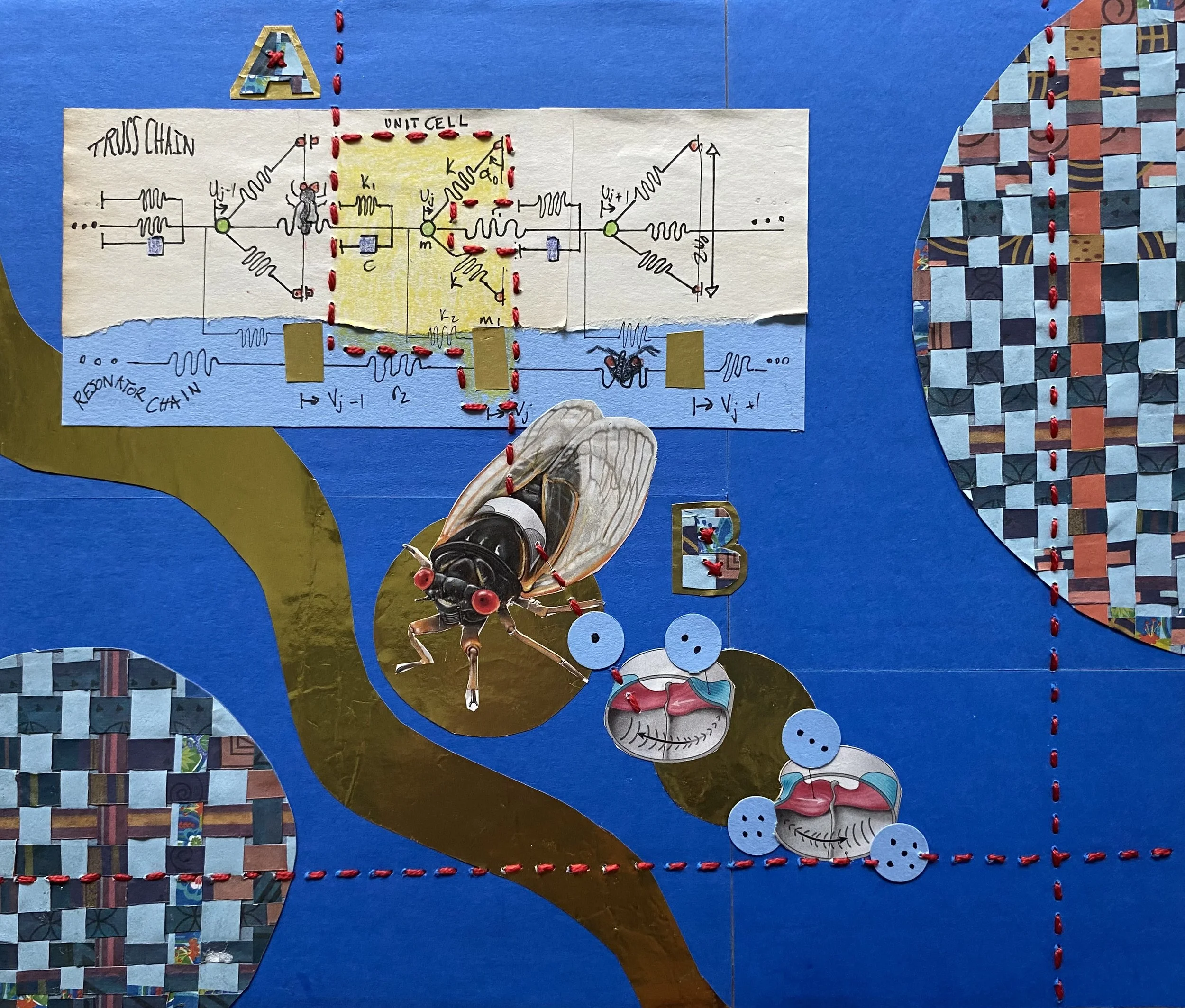
“Cicada Tymbal” Collage by Ace Lane, 2026
INTRO
When I first moved to North Carolina from California for college, I took night walks to bathe in the raucous bio-soundscapes of the long-held whirrs of the cicadas and the conversational scratchy chirps of the katydids. My roommate told me, “We call them katydids because, when they talk, one says ‘Katy did,’ and the other says ‘Katy didn’t.’” As the hesitant end of the NC piedmont’s steamy summer approaches, I show gratitude to creatures that donate such din.
Katydids chat using stridulation (rubbing their wings together [1]). Cicadas, on the other hand, have a different anatomic approach for their proclamations: a specialized drum-like organ called the tymbal. The tymbal sonifies with the rapid chain reaction of buckling and unbuckling of a series of chitinous ribs, membrane-bound and powered by muscle. This “snap-buckling” resonates in the special shape and material of the tymbal cavity, causing it to be LOUD. This collage describes this pea-sized organ that makes a sound the size of an airhorn, which evolved more than 300 mya [2].
COMMENTARY / ARTIST’S STATEMENT
About the Surrealist Figures series: This series uses surrealist collage to communicate data in dimensions beyond the “pure” science or mathematics of a given topic. Science does not exist in a vacuum; we observe phenomena through the filters of what our own bodies can perceive, which is an inherently incomplete view when considering what we are physically incapable of perceiving, assisted or not. Our perception incorporates the subconscious input of memory and imagination, drawing from humanity’s diversity of culture and education, and ecological context of ourselves and our subjects. A surrealist approach contextualizes scientific studies, rather than treating data and conclusions as objective and/or monolithic. Humans want with all of their hearts to make the subjective objective to make others believe them. I unabashedly lean into subjective.
About this collage: Cicada Tymbal was an exercise that led to the ideation of this series. It shows literal and abstract representations of how a tymbal functions: an anatomical diagram (Panel B) and a mechanical model (Panel A). Unlike my previous digital collage representing data and impact from a scientific journal publication, this collage is physical, made from scientific figures without digital fabrication tools on my part. Data are the soul of scientific figures, and their precise complexity would usually require printing or digital rastering. I did have the clipping of the digitally-printed anatomical diagram, but the rest of this is all analog, baby.
Due to my current housing situation, most of my studio is in storage except for a tote bag of tools and materials. Among the clippings I saved was this diagram of a tymbal (Panel B) from Scientific American. Without other directly related materials, I reconstructed a mechanical model from Ghoshal et al. (Nature Communications, 2025, [4]) by hand, with special modifications. Materials: tea-dyed white paper, blue colored paper, Micron pen, Prismacolor colored pencil, handwoven scrap paper, faux gold foil, and Finca perlé cotton.
PANELS
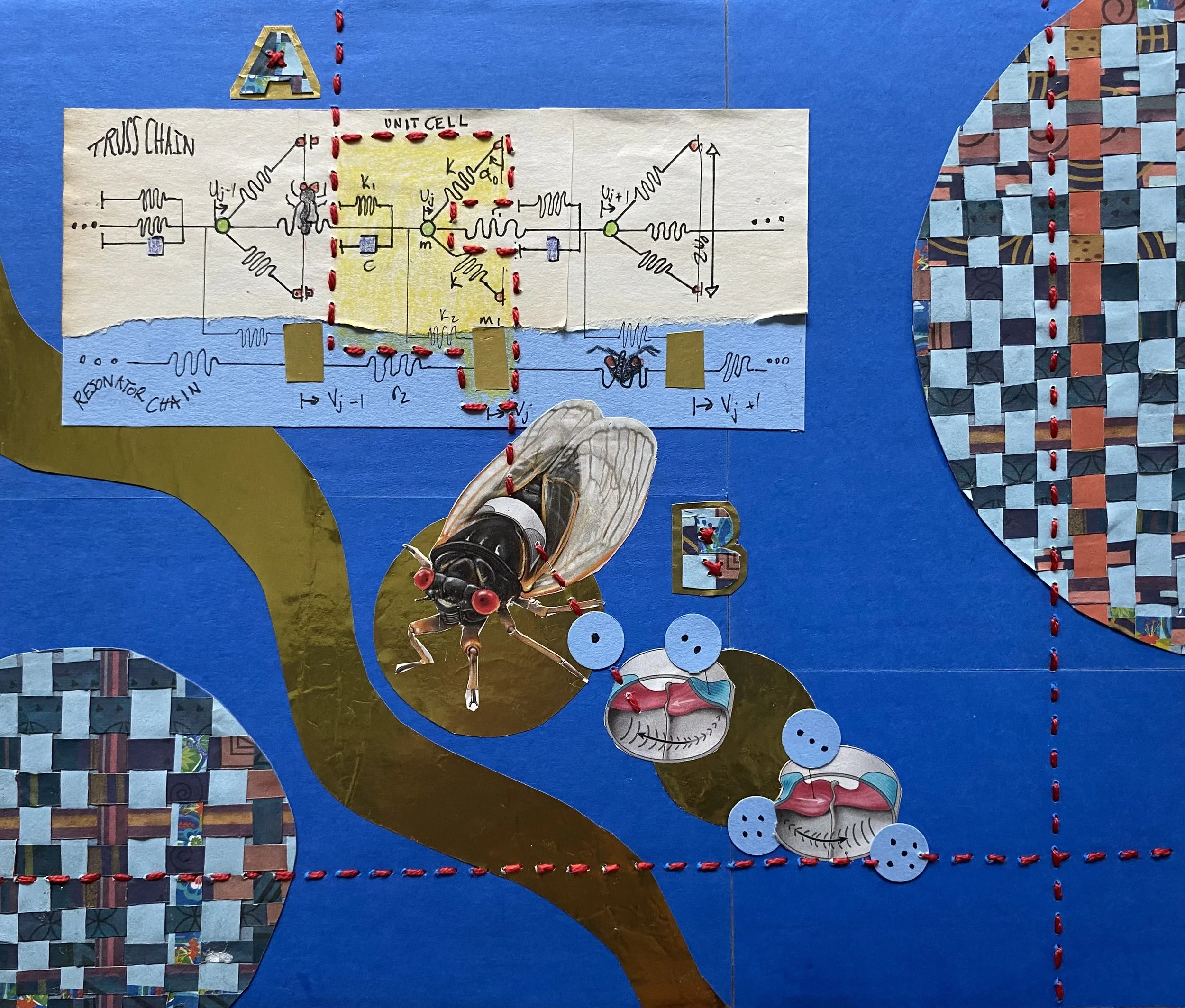
PANEL A:
Rendition of Model from Ghoshal et al 2025 [4]. This diagram is an engineer’s representation of the mechanics of a tymbal. The “truss chain” and “resonant chain” parallel diagrams model the tymbal movement and the abdominal resonators, respectively. The tymbal’s function is called a truss chain because “truss” in mechanical modeling refers to a curved reinforced structure. The truss is an engineer’s representation of the mechanical behavior of one rib and its elastic connections to neighboring ribs through the membrane. The truss model has two stable configurations and alternates between them through snap-through buckling. The buckling between these states is called “bistability.” See a more exhaustive breakdown below panel B’s description.
PANEL B:
• Abdominal segment ; •• Alternate tymbal clicking ; ••• : Tymbal muscle ; •••• : Tymbal clicking ; ••••• : Hollow chamber.
Rearrangement of illustration from Scientific American [3]. I have heard snap-through buckling and resulting resonance of the tymbal being compared to the tension and compression of a bendy straw [5], but that’s only correct as far as the movement between one configuration (compressed) and another (stretched out) causes an amplified sound due to the individual units (ridges in a straw) being connected by a membrane (plastic between ridges) within a resonant chamber (the rest of the straw). This is an incomplete comparison because: 1) The tymbal rib structure is not shaped like a bendy straw, 2) a tymbal’s ribs individually change between bent and unbent configurations, one at a time but quickly in a wavelike fashion modulated by muscle, not all at once like you would by using your fingers to compress/stretch a bendy straw, and 3) the cicada tymbal is far louder, due to its resonant structure. Think of resonance like tapping a bell and it rings loud - your finger taps a bell, but the sound is only loud because of the shape and material of the bell. Imagining snap-through buckling within a tymbal reminds me of the rolling velvet ridged hills in Fantasia’s visual rendition of Toccata and fugue in D minor (skip to 7:11).

PANEL A CONTINUED
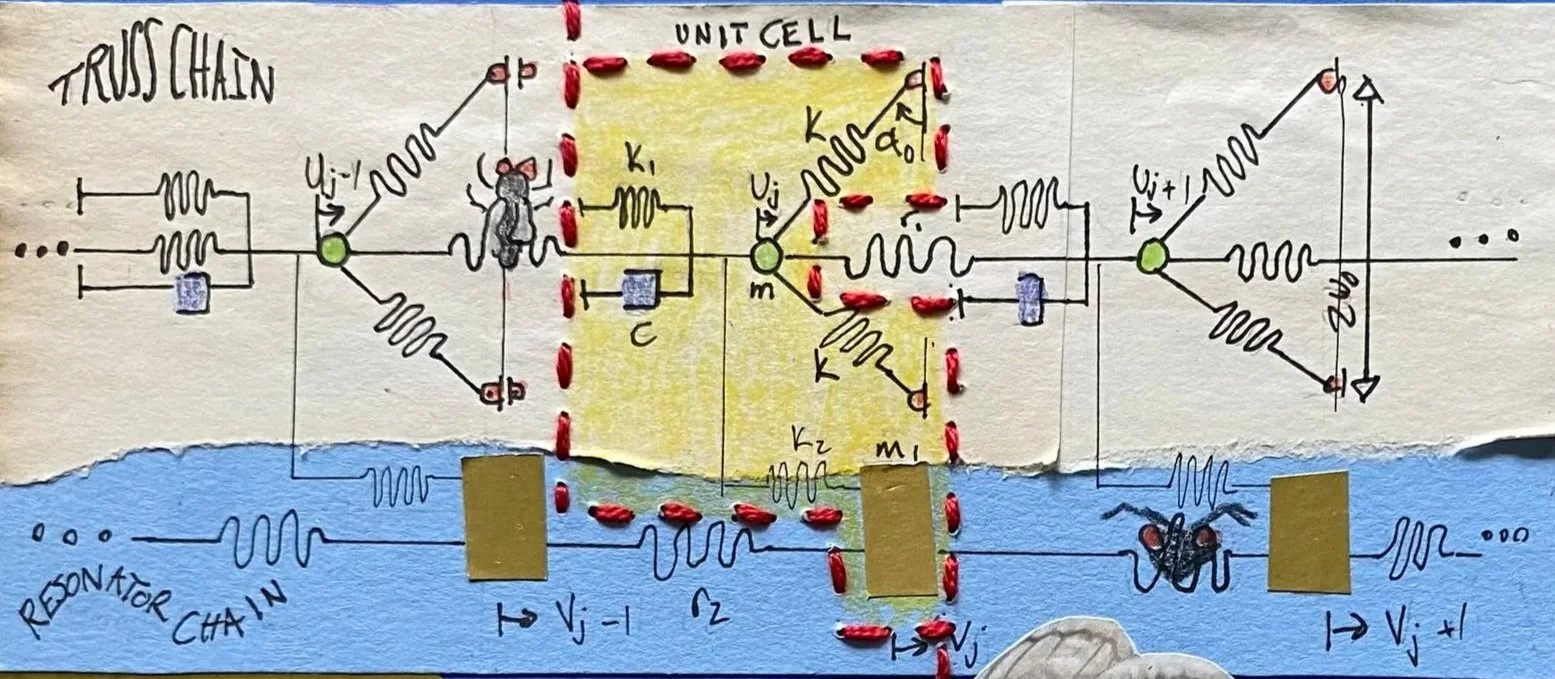
Here’s what the symbols mean. This is an abstract representation of the physics of the tymbal and resonant abdomen systems. I appreciate this diagram because I KNOW this scientist/engineer had a great time making this. I f*ck with that, live your best life, engineer. This is my first time comprehending a diagram like this, and I spent more time understanding this model than creating the collage… I am far from an expert, so take this with a grain of salt. Shoutout to Guoming Zhu at Michigan State University for the most accessible description of spring-damper systems I could find. Engineers, please contact me if I you have any corrections.
Left to right, top to bottom:
TOP PART
The tuning-fork-like symbol is a “boundary element,” which represents how the end of the modeled chain interacts with whatever lies beyond it. So, in this case, whatever lies BEFORE it.
Horizontal springs: The pulling of the next truss unit through the membrane
K1 = stiffness of horizontal connections between neighboring trusses
Green circles = effective mass associated with one “truss unit” (approximately one rib plus surrounding membrane)
M = mass
Diagonal springs = show the force that enables that “snap-through buckling” by stretching and compressing between two stable forms (rather than transitioning smoothly) for one truss unit.
K = stiffness of diagonal truss members (think of a brittle buckling vs. a smooth buckling)
Ui = the measurement of how far that rib moves inward horizontally from its resting or “equilibrium” (initial) state when in the displacement phase. These are described in three units represented here, each with the boundary element at the left, each representing the model of the movement of one truss. The “present” one in the middle (ui) is outlined in red perle cotton. So the previous/first one is ui-1, the present/middle one is ui, the next/right ui+1; it just shows the sequence order.
We have a few variables here that represent dampers. Dampers are anything that causes the loss of energy in the system, dampening the sound. This can be air, tissues, friction, or sound radiation (loss of noise to the world, some to your eardrums)
C: small grey box representing all damping associated with truss in motion
r1: dashpot (my mom would say “dashpot is a good name for a dog”), which is a mechanical symbol for a viscous damper, so like a piston moving through oil… the faster it moves, the larger the resisting force (I suppose my dog is dashpot-like in his resistance to relinquishing forbidden items when I try to pry them from his maw). The damper and spring attach the same two masses and act simultaneously.
Alpha: Refers to the engineering modeling analogy of an angle that determines the geometry of a rib in the tymbal in its stable, undeformed position. It represents the bistability between the initial angle and an alternate angle when “buckled.” It’s not the actual anatomical angle of the rib.
BOTTOM PART
Resonator chain: the bottom area is the resonant response of the abdomen cavity to tymbal motion. This shows how the air chamber in the tympana, the abdominal wall, etc. all work together to filter and amplify clicks produced by the tymbal.
Gold boxes: each a small mathematical model of one piece of the resonant system (so, like a small local portion in the abdomen that consists of the abdominal wall and the air inside). It’s the oscillator, meaning that it vibrates and resonance occurs when it’s excited near its natural frequency.
R2: damper like the r1 damper on top part, but connects resonator masses instead of truss masses
K2 springs describe how vibrations move through resonant structures
Vi is the same as ui, but now it’s the motion of the resonating abdominal system, not the rib
2w0 is the vertical height of one truss
CONNECTING TOP AND BOTTOM
Unit cell: (outlined in red) this is just one unit that repeats over and over again. The repetition on either side in the diagram is just there to show more information, as there is not enough room in one unit to break down all of the variables.
The left side arrow represents the “transmitting boundary,” where waves continue propagating out of the modeled region.
The right side shows the “reflecting boundary,” where waves bounce back into the modeled region.
Dots are like an actual “…” showing there is stuff before or after “…” It just means ”and so on.”
Note that the top part and the bottom part are coupled vertically! Read all of this back through but pay attention to things that are aligned vertically.
The vertical springs connect the top circles to the bottom squares. Those springs are what couple the tymbal to the abdominal resonators. The snapping tymbal rib transfers energy into the resonating abdomen.
CITATIONS
Baker, A. A., Jonsson, T., Aldridge, S. & Montealegre-Z, F. Complex wing motion during stridulation in the katydid Nastonotus foreli (Orthoptera: Tettigoniidae: Pseudophyllinae). J. Insect Physiol. 114, 100–108 (2019).
Wessel, A., Mühlethaler, R., Hartung, V., Kuštor, V. & Gogala, M. The tymbal: Evolution of a complex vibration-producing organ in the tymbalia (Hemiptera excl. Sternorrhyncha). in Animal Signals and Communication 395–444 (Springer Berlin Heidelberg, Berlin, Heidelberg, 2014).
Habib, M. B. Fossils Reveal When Animals Started Making Noise. Scientific Americanhttps://www.scientificamerican.com/article/fossils-reveal-when-animals-started-making-noise/ (2022).
Ghoshal, P. et al. The tymbal of a cicada: nature’s sound-generating metastructure. Nat. Commun. 16, 10270 (2025).
Prichard, P. American Cicada “Apocalypse”. https://site.extension.uga.edu/paulding/2024/04/american-cicada-apocalypse/.
